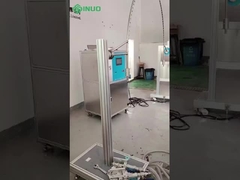
How We Solve the Critical IEC 61851-23 Side B Anchorage Test Challenges?ges

EVSE Testing Equipment
December 22, 2025
Category Connection: EVSE Testing Equipment
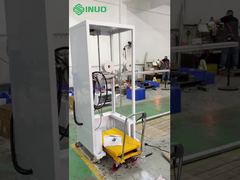
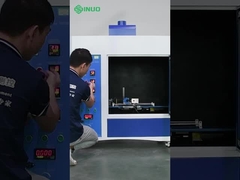
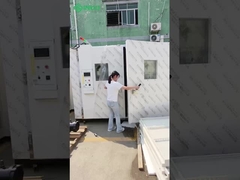
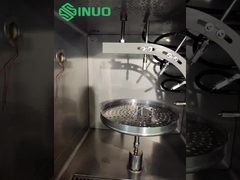
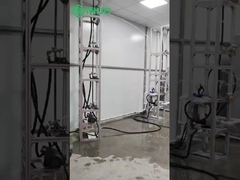
Brief: Here’s a fast, informative look at how our testing equipment solves the critical IEC 61851-23 Side B anchorage test challenges. You'll see a demonstration of the SNQC1007B system performing precise cable pull and torque tests, ensuring EV charging stations meet strict international safety standards through reliable, repeatable compliance verification.
Related Product Features:
  • Engineered for compliance with IEC 61851-23:2023 clause 11.6.102, Figure 110, Figure 111, and Table 114 standards.
  • Performs high-precision EVSE cable anchorage pull force and torque tests with PLC intelligent control and motor-driven force application.
  • Features customizable test parameters including pull cycles (1-999999) and torque application time (0-99H59M59S) for flexible testing.
  • Delivers stable and repeatable results with precision weight loading for specified tensile forces (160N to 500N) and torque (0.6N*m to 16.3N*m).
  • Includes an adjustable fixture height from 500 to 1200 mm to accommodate various charging station cable outlet positions.
  • Equipped with power failure protection and data storage memory to ensure test continuity and result integrity.
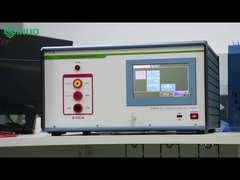
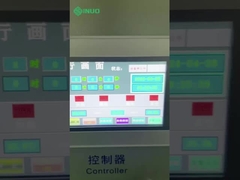
  • Offers an intuitive touch-screen interface for effortless operation, suitable for both experienced technicians and first-time users.
  • Simulates real-world pull and twist conditions to validate EV charging infrastructure safety and reliability.
FAQs:
  • What standards does the IEC 61851-23 EVSE Cable Anchorage Test Equipment comply with?
    The equipment is designed and manufactured in strict accordance with IEC 61851-23:2023, specifically clause 11.6.102 and referencing Figure 110, Figure 111, and Table 114, ensuring it meets international compliance requirements for EV charging station safety tests.
  • How is the pull force and torque applied during testing?
    Pull force and torque are applied through a motor-driven system using precision weight superposition. This method allows for accurate application of specified forces (e.g., 160N to 500N for pull, 0.6N*m to 16.3N*m for torque) in a stable and repeatable manner.
  • Can the equipment test charging stations with different cable outlet heights?
    Yes, the equipment features an adjustable fixture with a height range from 500 mm to 1200 mm, allowing it to accommodate and test EV charging stations with various cable outlet positions effectively.
  • What happens if there is a power failure during a test?
    The system is equipped with power failure protection and data storage memory functionality, which preserves test data and allows the test to resume from the point of interruption once power is restored, ensuring no loss of critical compliance verification data.