Do EV Charging Cables Pass IEC 61851-23 Pull and Torque Requirements?

EVSE Testing Equipment
December 19, 2025
Category Connection: EVSE Testing Equipment
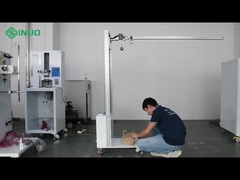
Brief: Watch this overview to discover why many professionals pay attention to this approach. This video provides a detailed walkthrough of the EVSE Cable Anchorage Test Equipment, demonstrating how it validates EV charging cables against IEC 61851-23 pull and torque requirements. You'll see the PLC automatic control system in action, performing precise tensile force and torque tests to ensure compliance with international safety standards.
Related Product Features:
  • Automatically performs cable pull and torque tests according to IEC 61851-23:2023 clause 11.6.102 standards.
  • Features PLC intelligent control with touch screen operation for effortless parameter setting and test execution.
  • Applies precise pull forces from 160N to 500N using weight superposition for accurate testing.
  • Delivers torque testing capabilities ranging from 0.6N•m to 16.3N•m through calibrated weight loading.
  • Offers adjustable fixture height from 500mm to 1200mm to accommodate various charging station cable outlet positions.
  • Includes power failure protection with data storage memory to preserve test results during unexpected shutdowns.
  • Provides customizable test cycles from 1 to 999999 cycles with default setting of 100±1 cycles.
  • Ensures stable and repeatable test results through electric drive mode and precision mechanical structure.
FAQs:
  • What standards does this EVSE cable test equipment comply with?
    The equipment is designed and manufactured according to IEC 61851-23:2023 clause 11.6.102 and Figure 110, Figure 111 and Table 114, ensuring full compliance with international testing requirements for EV charging station cables.
  • What range of pull forces and torque can this equipment test?
    The system tests pull forces of 160N, 200N, 240N, 250N, and 500N, and torque values of 0.6N•m, 0.7N•m, 1.4N•m, 2.7N•m, 5.4N•m, 11.0N•m, and 16.3N•m, all achieved through precise weight superposition.
  • How does the equipment handle different charging station configurations?
    The system features an adjustable fixture height ranging from 500mm to 1200mm, allowing it to accommodate and test charging stations with different cable outlet positions and configurations.
  • What safety features does the test equipment include?
    The equipment includes power failure protection with data storage memory function, ensuring test data is preserved during unexpected power interruptions and preventing data loss during critical testing procedures.