logo

products details

Created with Pixso. Home Created with Pixso. Products Created with Pixso.
Electric Vehicle Testing Equipment
Created with Pixso.

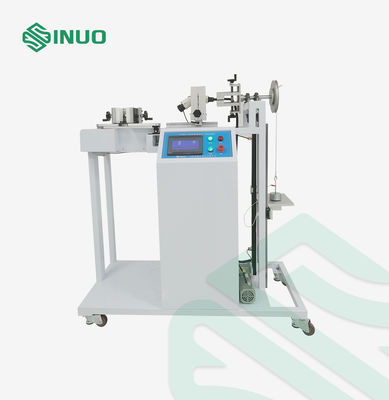
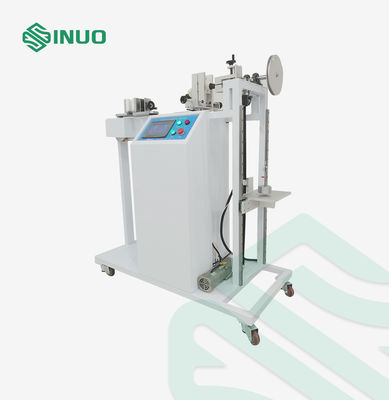
IEC 62196 EV Connector Pull & Torque Test Apparatus for Cable Anchorage Strength Test

IEC 62196 EV Connector Pull & Torque Test Apparatus for Cable Anchorage Strength Test

Brand Name: Sinuo
Model Number: SNQC1007
MOQ: 1
Price: Customized
Payment Terms: T/T
Supply Ability: 10 Sets/Month
Detail Information
Place of Origin:
China
Certification:
Calibration Certificate(Cost Additional)
Standard:
IEC 62196
Operation:
Button Control
Drive Type:
Motor & Cylinder
Pull Force:
160N~600N
Torque Range:
0.6Nm~11Nm
Power Supply:
AC220V, 10A
Packaging Details:
Plywood case
Supply Ability:
10 Sets/Month
Highlight:

IEC 62196 EV connector pull test apparatus

,

EV connector torque test apparatus

,

cable anchorage strength test equipment

Product Description

IEC 62196 EV Connector Pull & Torque Test Apparatus for Cable Anchorage Strength Test

Product Overview

Our cable anchorage pull & torque test apparatus is a dedicated mechanical validation bench built for electric vehicle charging plugs, socket outlets and vehicle connectors. It validates whether the cable anchorage structure can withstand specified axial pull load and twisting torque, a mandatory test item for IEC certification of EV charging couplers.

The machine strictly follows IEC 62196-3:2026 Clause 25, IEC 62196-1:2025 Clause 25.3 Figure 21 Table 15 and IEC 60309-1:2012 Clause 23.3. It adopts dual drive configuration: adjustable single-phase speed regulating motor for cyclic pull test, pneumatic cylinder release structure for static torque loading. It is widely used by EV connector manufacturers, charging gun factories, third-party testing labs and certification bodies across Europe, Southeast Asia and Latin America.

IEC 62196 EV Connector Pull & Torque Test Apparatus for Cable Anchorage Strength Test

Core Advantages

  • Compliant with the latest IEC 62196-1:2025 standard table 15 pull & torque value matrix, covering rated current 5A~800A EV plugs
  • Combined motor + air cylinder driving system, separate control for pull cycling and torque holding
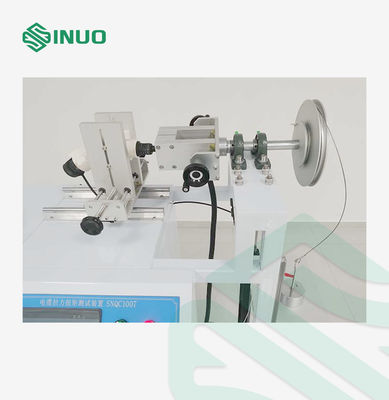
  • Weight group configuration, accurate graded load output, no complex software calibration required
  • Presettable cycle counter and torque holding timer, convenient for long-duration static load testing
  • Universal fixture set included, compatible with most AC & DC EV charging plugs and vehicle connectors
  • Mobile caster frame design, easy relocation inside test laboratory, stable mechanical structure
  • Supports third-party calibration to issue test reports for CB, CE certification submission

IEC 62196 EV Connector Pull & Torque Test Apparatus for Cable Anchorage Strength Test

Technical parameters:

Operation Method

Button operation

Drive Mode

Motor and cylinder

Pull Force Weights

40N*1, 50N*1, 60N*1, 100N*2,250N*1

Can achieve 160N, 200N, 240N, 250N,500N,600N pull force

Torque Weights

6N*1, 7N*1, 12N*1, 15N*1, 23N*1, 110N*1

Can achieve 0.6N.m, 0.7N.m, 1.2N.m, 1.5N.m, 2.3N.m, 11N.m torque

Torque Arm

Ф200mm

Pull Frequency

1 cycle/s

Pull Cycles

1-999999 cycles, can be preset, default 100 cycles

Torque Applied Time

0.01S ~ 99 hours 59 minutes 59 seconds, default 1 min

Fixture

One set of universal fixtures

Equipment Dimensions & Weight

L 1560mm*W 600mm*H 1530mm, approx. 220KG

Power Supply

Single phase AC220V±10%, 50/60Hz, 10A

IEC 62196 EV Connector Pull & Torque Test Apparatus for Cable Anchorage Strength Test

Test Principle

For pull test: Eccentric cam mechanism driven by adjustable speed motor generates repeated pulling force, simulating cable pulling stress during daily plug operation. The cycle count will stop automatically once reaching preset cycles. For torque test: Torque weight is released by air cylinder to apply static twisting load on cable anchorage, maintain torque for configured time, check cable displacement and anchorage failure after test. Test judgment refers to the maximum allowable displacement from IEC 62196-1 Table15.