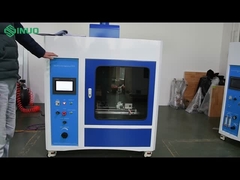
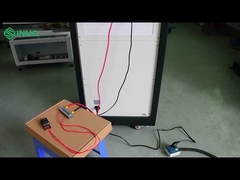
Brief: See how this offering can bring practical value to common tasks and projects. In this video, we demonstrate the EV Connector Testing Equipment in action, showing you how it evaluates the mechanical strength and flexibility of electric vehicle charging connectors and plugs. You'll get a walkthrough of its precise servo-controlled movements, specimen mounting process, and how it simulates real-world bending stresses to ensure your components meet international standards like IEC 62196-1.
Related Product Features:
Evaluates mechanical strength and flexibility of EV charging connectors, plugs, sockets, and couplers according to IEC 62196-1 and IEC 60309-1 standards.
Utilizes servo motor drive for precise, repeatable swing angles with minimal lateral displacement, ensuring reliable test results.
Features PLC intelligent integrated control with a 7-inch HMI touch interface for easy operation and monitoring.
Allows adjustable bending angles from 0-360° and bending cycles from 0-999,999, with presettable rates of 0-60 cycles/min.
Supports multiple load weights including 20N, 25N, 50N, 75N, 100N, and 140N for versatile testing scenarios.
Designed for heavy-duty testing with AC220V±10% / 50-60Hz power input and a stable 3KW power rating.
Securely mounts large-size specimens on durable aluminum plates with mechanical clamping and adjustable position.
Includes optional external load cabinet with adjustable voltage (0-250V) and current (AC 0-400A) for comprehensive testing.
FAQs:
What international standards does this EV Connector Testing Equipment comply with?
The equipment conforms to IEC 62196-1:2014 clause 7.11 and clause 7.15, and IEC 60309-1:2012 clause 24.4, ensuring your EV charging connectors meet global mechanical strength and flexibility requirements.
How does the testing equipment simulate real-world stress on EV connectors?
It uses a servo motor to drive a turntable that oscillates test samples through controlled left-right movements, with the swing axis precisely aligned at the cord entry point. This configuration accurately simulates repeated bending stresses encountered in actual use.
What are the key technical specifications for the bending cycles and angles?
The equipment allows presettable bending cycles from 0 to 999,999 (default 20,000) and adjustable bending angles from 0-360° (default ±45°), with a bending rate of 0-60 cycles per minute, providing flexibility for various testing needs.
Is this equipment suitable for testing large or heavy EV connector specimens?
Yes, it is designed to securely mount large-size specimens on durable aluminum plates using mechanical clamping with adjustable position, and it supports load weights up to 140N, making it ideal for heavy-duty testing environments.